Practical Performance Engineering for Next-Generation GPUs — Empirical Comparison of NVIDIA H100 and B200
Overview
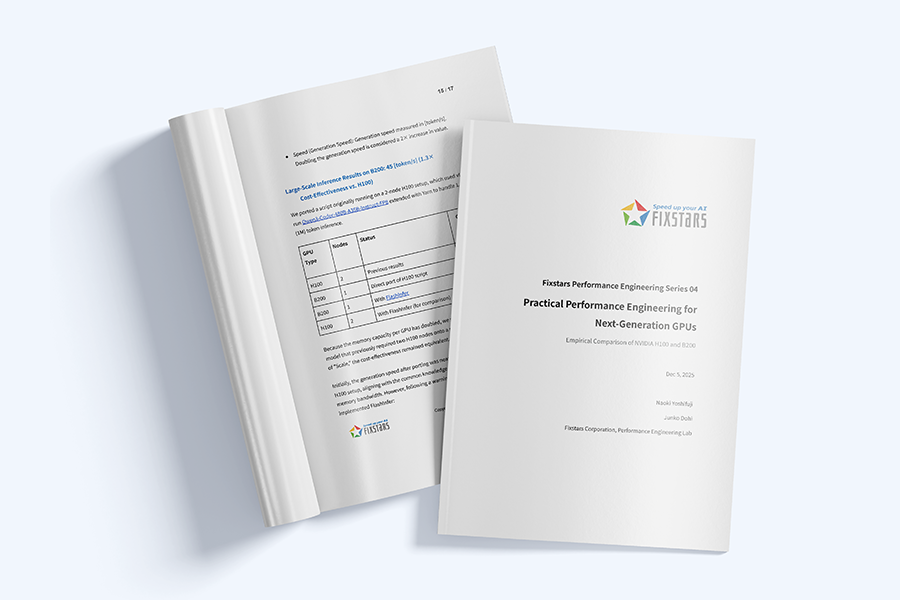
This technical report provides a deep dive into the performance of the NVIDIA B200 GPU, the successor to the Hopper architecture. Conducted in collaboration with SAKURA internet on the "Koukaryoku PHY" cloud, our research demonstrates how to unlock the full potential of Blackwell-based systems. We show that through strategic version selection and architectural tuning, a single B200 node can outperform a 2-node H100 configuration, delivering up to 4× higher cost-effectiveness in LLM pre-training and significant gains in massive-model inference.
What You'll Learn
- B200 vs. H100/H200 Comparison: A detailed analysis of architectural advances, including the impact of FP4 Tensor Cores and doubled memory bandwidth.
- Optimal Environment Construction: Practical guidelines for selecting AI frameworks (Megatron-LM), PyTorch, CUDA, and GPU drivers specifically for the Blackwell architecture.
- Pre-training Efficiency: Case study on Llama3 70B continued pre-training, achieving 4× better cost-performance by optimizing sequence length and precision (FP8).
- Large-Scale Inference Gains: How the introduction of FlashInfer for Blackwell (SM 10.0) boosted inference speed for 480B parameter models to 45 tokens/s.
Recommended For
- AI Infrastructure Engineers evaluating the migration from H100/H200 to B200 clusters.
- Machine Learning Researchers looking to optimize training throughput and sequence length for LLMs.
- CTOs and IT Decision Makers seeking data-driven insights into the cost-efficiency of next-generation GPU investments.