Overview
-
Co-developed and launched a simulation toolset for AD/ADAS software that takes full advantage of the in-vehicle "R-Car" SoC.
-
Develop lightweight network models and simulate them without deep prior knowledge of the R-Car platform.
-
Simulation results feed back into model development immediately — shortening the iteration cycle.
Background
As an in-vehicle SoC vendor, Renesas was building an integrated development environment so it could deliver products with a "software-first" approach.
AD/ADAS applications rely on deep learning. Optimizing those models and making the most of R-Car's performance required advanced software engineering expertise — and significant development cost.
Challenge
Real-time processing on in-vehicle SoCs is hard. Limited compute units and memory mean models and runtime programs must be lightweight and tightly optimized — heavy lifting for development teams.
That lightweighting often drops inference accuracy too, forcing model rework. Evaluating and validating on real silicon makes the loop slow.
Solution
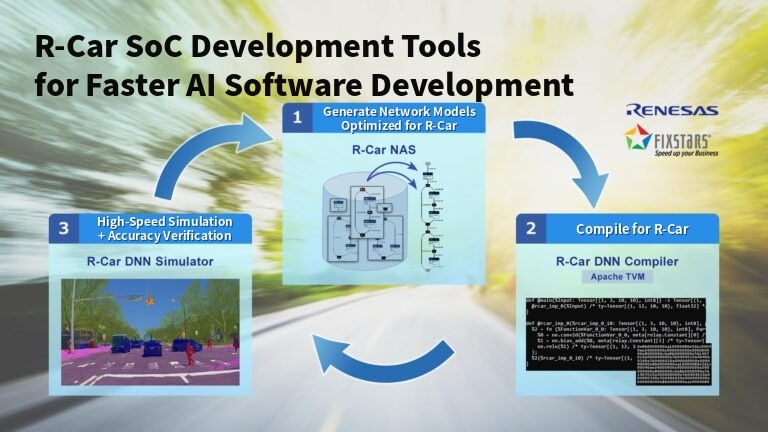
We co-developed three tools that cover the full path — from generating deep learning network models to optimization, compilation, and simulation:
- R-Car NAS (Neural Architecture Search) — generates network models tuned for R-Car
- R-Car DNN Compiler — compiles network models for R-Car
- R-Car DNN Simulator — runs compiled programs in fast simulation
R-Car NAS produces lightweight network models that meet accuracy and processing-time requirements.
R-Car DNN Compiler turns the network model into a program that draws on R-Car's full performance — fast execution with memory optimization that makes the most of R-Car's compact SRAM.
R-Car DNN Simulator validates program behavior without real R-Car silicon, returning results equivalent to running on the chip.
Used together, the three tools let teams develop AD/ADAS applications that pull peak performance out of R-Car — without deep prior knowledge of the chip, and in a fraction of the time it used to take.