World’s largest quantum circuit simulation for quantum chemistry achieved on 1,024 GPUs
Enabling large-scale benchmarking and validation of quantum algorithms for realistic molecular systems, supporting future industrial applications of quantum computing
Osaka, Japan and Irvine, California, USA – A joint research team between the Center for Quantum Information and Quantum Biology (QIQB) at The University of Osaka and Fixstars Corporation has demonstrated one of the world's largest classical simulations of iterative quantum phase estimation (IQPE) circuits for quantum chemistry on up to 1,024 GPUs, surpassing the previous 40-qubit limit. The result expands the scale of molecular systems available for the development and validation of quantum algorithms for future fault-tolerant quantum computers, supporting progress toward industrial applications in drug discovery and materials development.
Overcoming unresolved challenges in drug discovery and developing new materials to address climate change will require advanced quantum chemical calculations beyond the reach of current technology. Against this backdrop, fault-tolerant quantum computers (FTQC) are widely anticipated as a key enabling technology, making it increasingly important to develop and validate, ahead of their deployment, the quantum algorithms that will eventually run on such systems.
Quantum phase estimation (QPE) serves as a core subroutine in many quantum algorithms and, in quantum chemistry, is expected to enable analyses that are difficult for current classical computers. The research group, consisting of Professor Wataru Mizukami, Assistant Technical Staff Shoma Hiraoka, and Assistant Technical Staff Sho Nishida at QIQB, and Yusuke Teranishi of Fixstars Corporation, focused on Iterative QPE (IQPE), a QPE-based method that requires fewer qubits, and implemented it in the quantum circuit simulator for quantum chemistry, “chemqulacs-gpu.”
The group also developed and applied a new parallel computing technology to maximize the performance of large-scale
GPU clusters. As a result, they exceeded the previous limit of 40 qubits for state-vector-based quantum circuit
simulations for quantum chemistry reported in earlier studies and successfully carried out one of the world’s largest
such simulations.
The simulations achieved the following results:
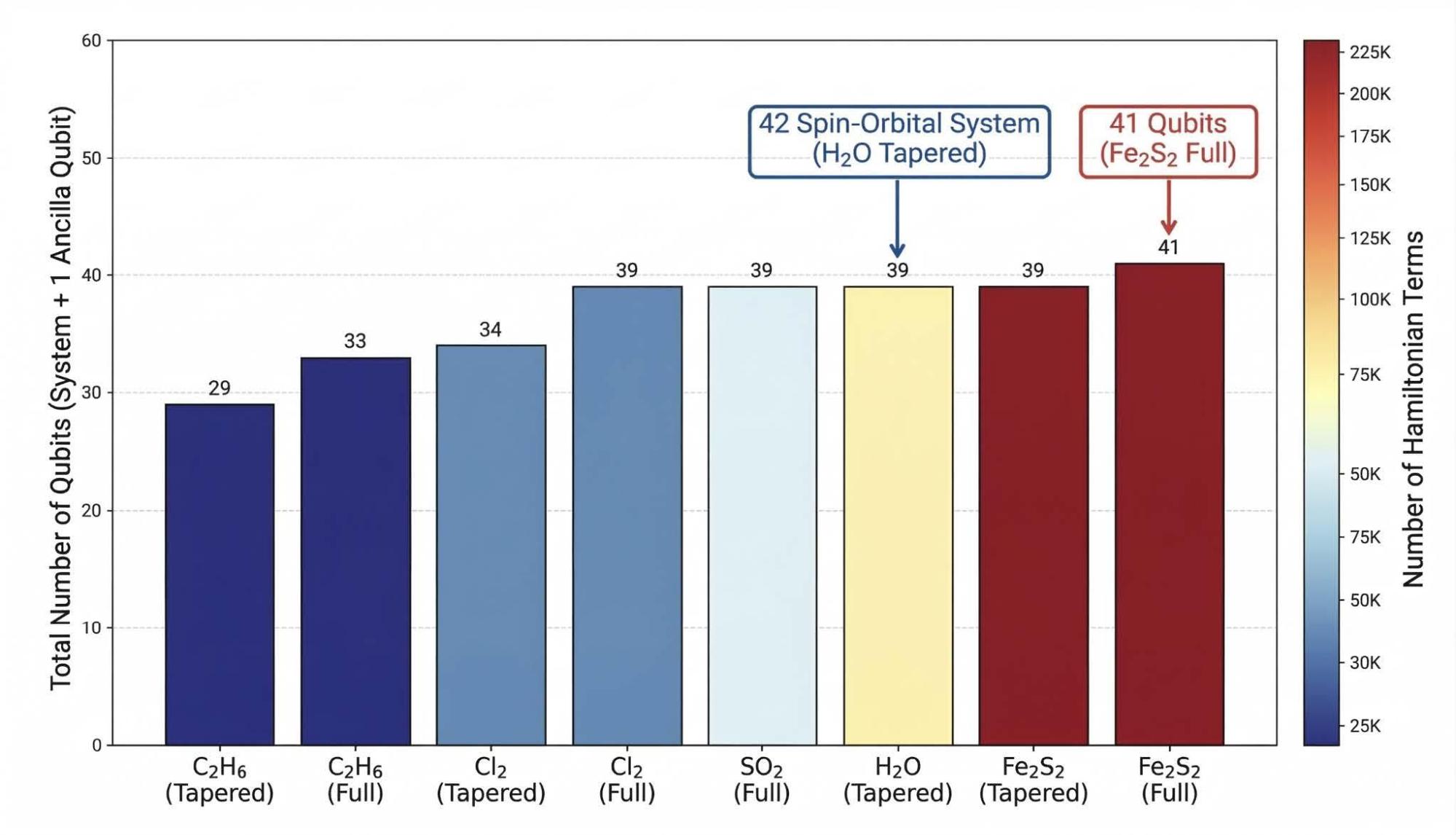
- Largest problem size: calculation of a 42-spin-orbital system for an H₂O molecule (with qubit reduction technology applied)
- Largest circuit size: calculation of a 41-qubit circuit for an Fe₂S₂ molecule (pure circuit-scale benchmark)
To achieve this result, the team implemented IQPE in the quantum chemistry simulator “chemqulacs-gpu” and developed a parallel computing method optimized for large-scale GPU clusters. Using up to 1,024 NVIDIA H100 GPUs on AIST’s ABCI-Q system, the researchers overcame conventional computational bottlenecks and extended quantum circuit simulations of quantum algorithms for quantum chemistry beyond the previous 40-qubit limit.
This achievement expands the range of molecules that can be targeted in the development and validation of quantum algorithms and supports further progress toward more complex and realistic molecular simulations on future fault-tolerant quantum computers.
Comment from Professor Wataru Mizukami
“Large-scale simulation of quantum circuits using 1,024 GPUs in unison is technically demanding, and within the limited 48-hour computation window we repeatedly encountered unexpected issues. I am delighted that the team, led by two young researchers, Yusuke Teranishi and Shoma Hiraoka, persevered throughout the effort, and that, with prompt support from the ABCI-Q operations staff, we were able to achieve one of the world’s largest results. I hope this accomplishment will help accelerate the development of quantum algorithms.”
Research collaboration
This research was conducted as a collaborative study based on the research plan of Professor Mizukami at QIQB. QIQB
led the research and development of methods for classically simulating IQPE quantum circuits on GPU clusters, and
implemented the interface connecting the quantum chemistry layer to the simulation layer.
Fixstars Corporation provided GPU performance profiling and optimization technologies, and was responsible for
optimizing the simulation code and tuning its performance on ABCI-Q. This work resolved complex inter-GPU
communication bottlenecks and enabled highly efficient circuit simulation.
Presentation information
The results was presented at NVIDIA GTC 2026, to be held in San Jose, California, in March 2026.
Presentation title:
P81339 - Efficient Iterative QPE Simulations for Quantum Chemistry using Distributed State-Vector Methods
Summary
A joint research team between the Center for Quantum Information and Quantum Biology (QIQB) at The University of Osaka and Fixstars Corporation has demonstrated one of the world's largest classical simulations of iterative quantum phase estimation (IQPE) quantum circuits for quantum chemistry on up to 1,024 GPUs, surpassing the previous 40-qubit limit. The result expands the scale of molecular systems available for the development and validation of quantum algorithms for future fault-tolerant quantum computers, supporting progress toward industrial applications in drug discovery and materials development.
Funded by:
Japan Society for the Promotion of Science
Ministry of Education, Culture, Sports, Science and Technology
Japan Science and Technology Agency
Notes
This work was supported by computational resources of the Quantum-AI Hybrid Computing Infrastructure (ABCI-Q), awarded under the “ABCI-Q Grand Challenge” Program of the National Institute of Advanced Industrial Science and Technology (AIST).
Reference URLs
Professor Wataru Mizukami Researcher Profile URL
https://rd.iai.osaka-u.ac.jp/en/3df5398d10c44be6.html
Fixstars Corporation Website
https://www.fixstars.com
About The University of Osaka
The University of Osaka was founded in 1931 as one of the seven imperial universities of Japan and is now one of
Japan's leading comprehensive universities with a broad disciplinary spectrum. This strength is coupled with a
singular drive for innovation that extends throughout the scientific process, from fundamental research to the
creation of applied technology with positive economic impacts. Its commitment to innovation has been recognized in
Japan and around the world. Now, The University of Osaka is leveraging its role as a Designated National University
Corporation selected by the Ministry of Education, Culture, Sports, Science and Technology to contribute to innovation
for human welfare, sustainable development of society, and social transformation.
Website: https://resou.osaka-u.ac.jp/en
About Fixstars Corporation
Fixstars is a technology company dedicated to accelerating AI inference and training through advanced software optimization solutions. It supports innovation in healthcare, manufacturing, finance, mobility, and other industries. For more information, visit: https://www.fixstars.com/