Overview
-
Application of Quantum-Inspired Technologies: We formulated the ore blending problem, which involves complex constraints, as a QUBO (Quadratic Unconstrained Binary Optimization) model. By utilizing an annealing algorithm that combines broad "Exploration" with the "Exploitation" of promising solutions, we consistently derived optimal solutions.
-
Revenue Enhancement: In short- to medium-term planning, areas where traditional linear programming often struggles, we succeeded in improving revenue by 5–10% compared to conventional methods, while strictly adhering to rigorous component specifications (copper grade and impurity concentrations).
-
Flexibility and Practicality: Leveraging Fixstars Amplify achieved practical computation speeds and offers the flexibility to handle multi-objective optimization, such as quarterly revenue targets and stockpile management.
Background
To meet strict client specifications (such as copper grade and impurity limits), copper mines must blend ore from multiple stockpiles with varying properties. This results in an extremely complex constrained nonlinear optimization problem.
Traditional linear programming faces difficulties in flexible exploration, particularly for short- to medium-term planning, making it hard to maximize revenue while fully accounting for complex chemical behaviors and inventory fluctuations.
As mining is a 10-billion-AUD annual business, a few percent improvement (5-10% in some cases) through quantum-inspired optimization will directly create hundreds of millions in value and maximize resource efficiency.
Solution
While current quantum computers face scale limitations to solve the ore blending problem, Fixstars Amplify provides a quantum-inspired, GPU-accelerated simulated annealing algorithm that can obtain solutions within practical processing times.
The key feature is formulating the problem as a QUBO model. Unlike traditional linear programming, which is constrained by a "feasible region," the QUBO approach treats constraint violations as "penalties." This methodology allows the system to flexibly search for optimal solutions by temporarily deviating from constraints.
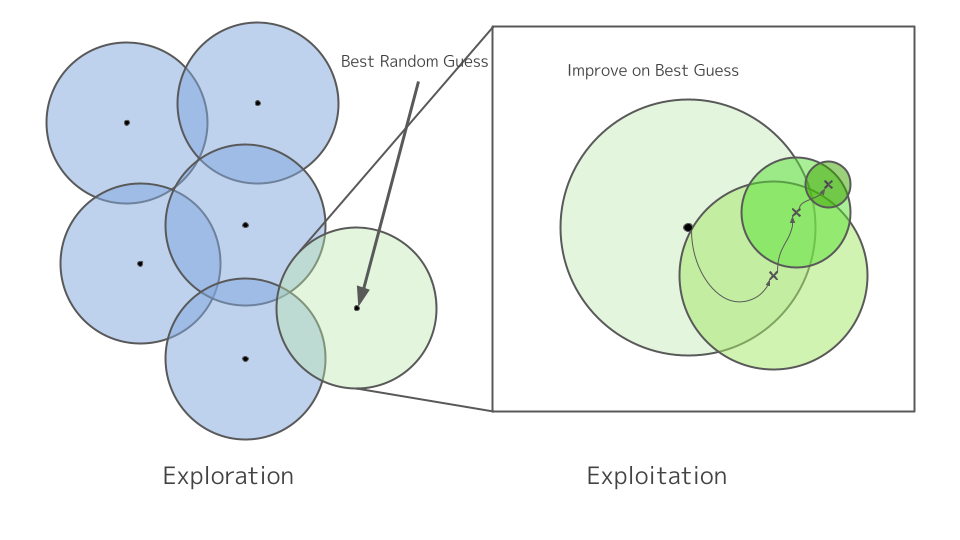
The specific search process is performed through two iterative stages:
- Exploration: Constraints are relaxed to roughly identify promising areas within a vast solution space.
- Exploitation: Constraints are tightened in the identified areas to enhance solution accuracy and feasibility.
This hybrid approach enables the derivation of high-revenue solutions that outperform conventional methods for complex nonlinear problems.